
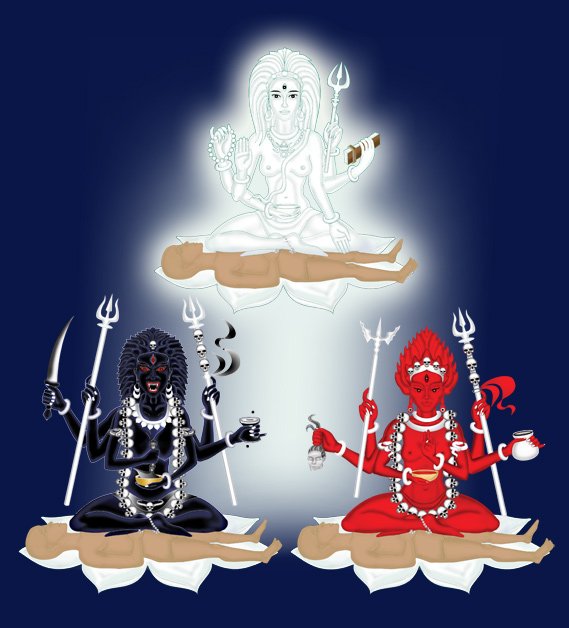
Guhya Kali dhyana shloka reveals a form that is not merely symbolic, but profoundly inward and experiential.
She is described as –
the one who is beyond all dualities; the pure and limpid stream of honey flowing from the lotus of the Vedas; the boat that carries the seeker across the ocean of worldly existence; the forest-fire that burns away the thirst for repeated birth; the destroyer of the darkness of delusion; and the radiant sun of supreme bliss. This Nirguna Guhya Kali is not distant or abstract—she is affirmed as the abiding Reality within one’s own heart.
As these are all highest of all vidyas, we are not sharing the dhyana shloka here.
It is this very Guhya Kali who expands Herself into three fundamental aspects: Apara, Para, and Paratpara. These are not separate deities nor philosophical categories imposed from outside, but intrinsic unfoldments of the same supreme Reality. Kali Tryara Puja is the worship of these three distinct forms of Guhya Kali, together with Her Nirvana Swarupa. This puja does not function at an introductory or preparatory level; it belongs exclusively to the highest stages of upasana, where worship itself becomes a vehicle of ascent.
In this puja, the thirty-six attributes of Guhya Kali take the form of thirty-six Kalikas, one Kalika representing each attribute and they are –
- nirvikara – changeless
- kootastha – the unshaken, immovable inner Reality
- chit – pure awareness
- ananda – bliss
- nirabhasa – without reflection or appearance
- advaita – non-dual
- nivritti – withdrawal from all outward movement
- akshara – imperishable
- avyakta satta – unmanifest existence
- paramartha – ultimate truth
- bhasa – inner illumination
- nitya – eternal
- shuddha – pure
- niranjana – unstained
- nistraigunya – beyond the three gunas
- kaivalya – absolute aloneness / perfect independence
- buddhi – awakened intelligence
- mukti – liberation
- prabodha – full awakening
- satya – truth
- pratyak – inward-turned awareness
- vijnana – direct knowing
- chaitanya – living consciousness
- sukshma – subtle
- karana – causal principle
- ashaya – inner ground or repository
- sat – being
- asat – non-being
- laya – dissolution
- anavrtti – no return
- avigraha – formless
- aikatmya – oneness of being
- prashanta – absolute peace
- agamya – beyond approach or grasp
- turiya – the fourth state beyond waking, dream, and sleep
- apunarbhava – freedom from rebirth
Considering the internet spirituality, we are not listing the 36 names of Kalika, but only her attributes here.
These 36 forms of Kalika are invoked and honoured through worship.
Guhya Kali is described as seated upon the Sapta Pretasana, a seat formed of seven pretas. This iconography must be understood carefully and traditionally. Each preta is worshipped with its own distinct mula mantra as part of the puja, emphasizing that even the foundations upon which the Devi is visualized are ritually alive and consciously integrated. Nothing in this worship is symbolic in a casual sense; every component is precise, deliberate, and mantra-bound.
She is encircled by sixteen Kalikas; each form of Kalika represents one tattva and they are –
- jyoti – light, illumination
- satta – existence, being
- jati – category, inherent nature
- cheshta – movement, activity
- yukti – order, right arrangement, method
- upadhi – limiting condition, imposed attribute
- upaya – means, method, approach
- upashama – quietening, subsiding, pacification
- bhava – state of being, inner disposition
- udaya – arising, emergence
- asta – setting, dissolution
- madhya – the middle, the central state
- janma – birth, coming into manifestation
- mrtyu – death, cessation
- vidhi – order, law, cosmic rule
- bodha – awareness, understanding, awakening
Again, here also – we are not mentioning the names of Kalika, but the tattvas she represent are listed above.
Beyond these sixteen Kalikas, Guhya Kali is accompanied by another set of twenty-seven Kalikas who represent –
- brahma – the creative principle
- vishnu – the sustaining principle
- rudra – the dissolving principle
- svarga – the higher realms
- martya – the mortal world
- patala – the lower realms
- prata – dawn
- madhyahna – midday
- sandhya – twilight
- bhuta – the past
- varttamana – the present
- bhavishya – the future
- para – the transcendent
- apara – the manifest
- parapara – both transcendent and manifest
- nada – primordial sound
- bindu – point of origin, seed
- shakti – dynamic power
- akara – the sound “A”, origin
- ukara – the sound “U”, continuity
- makara – the sound “M”, completion
- puraka – inhalation
- kumbhaka – retention
- rechaka – exhalation
- shambhava – the state of Shiva-consciousness
- turiya – the fourth state beyond waking, dream, and sleep
- nirvana – final release, complete dissolution
Through these Kalikas, time, space, sound, breath, and consciousness are brought into a single ritual mandala.
When Guhya Kali manifests in her Apara aspect, she is known as Adisargakali. In her Para aspect, she is known as Madhusargakali. In her Paratpara form, she is known as Antasargakali. Each of these three forms has its own distinct mantra, and each is worshipped independently. After the worship of these three, another set of sixteen Kalikas is worshipped again—this time they simply represent the expansion of the Apara, Para, and Paratpara forms.
These sixteen Kalikas represent sixteen vidyas: yoga vidya, veda vidya, vrata vidya, diksha vidya, yagnya vidya, mantra vidya, siddhi vidya, kula vidya, atma vidya, samaya vidya, samarasa vidya, dharma vidya, dana vidya, yuddha vidya, tapa vidya, and gnana vidya. These are not independent systems of knowledge borrowed from different traditions; they are direct expansions of the Apara–Para–Paratpara forms of Guhya Kali herself. Vidya here is not information—it is lived transmission, sustained through lineage and disciplined practice.
Kali Tryara Puja stands as a reminder that true spiritual systems are not assembled through personal preference, modern interpretation, or intellectual synthesis. They are received, preserved, and transmitted through tradition. In an age where sacred practices are increasingly simplified, aestheticized, or distorted to suit convenience and consumption, such pujas remind us that depth cannot be replaced by novelty, and authenticity cannot be manufactured.
Tradition does not restrict spiritual freedom; it safeguards it. It ensures that what is subtle is not trivialized, what is powerful is not misused, and what is sacred is not reduced to symbolism alone. Guhya Kali, in her Tryara form, reveals that the highest truths unfold only where discipline, lineage, and reverence are intact. To approach her outside this framework is not boldness—it is blindness.
In holding to tradition, the sadhaka does not walk backward into the past, but forward with clarity, protected from distortion, and aligned with a wisdom that has already tested the limits of time.

- PANCHAYATANA – GANAPATI PUJA - September 8, 2026
- Introduction to Panchayatana Puja: The Five-Seat Path to Advaita - September 7, 2026
- Pulluvar of Kerala: Naga Vidya, Naga Rituals and the Trance of Sarpam Thullal - August 11, 2026

Nice information
Very good. Sir ,could you pl gude for getting invitation of Raseswari and Rasabhairava, presently iam an upasaka of soubhagya panchadadi, and practitioner in siddha systam of ayurveda.