
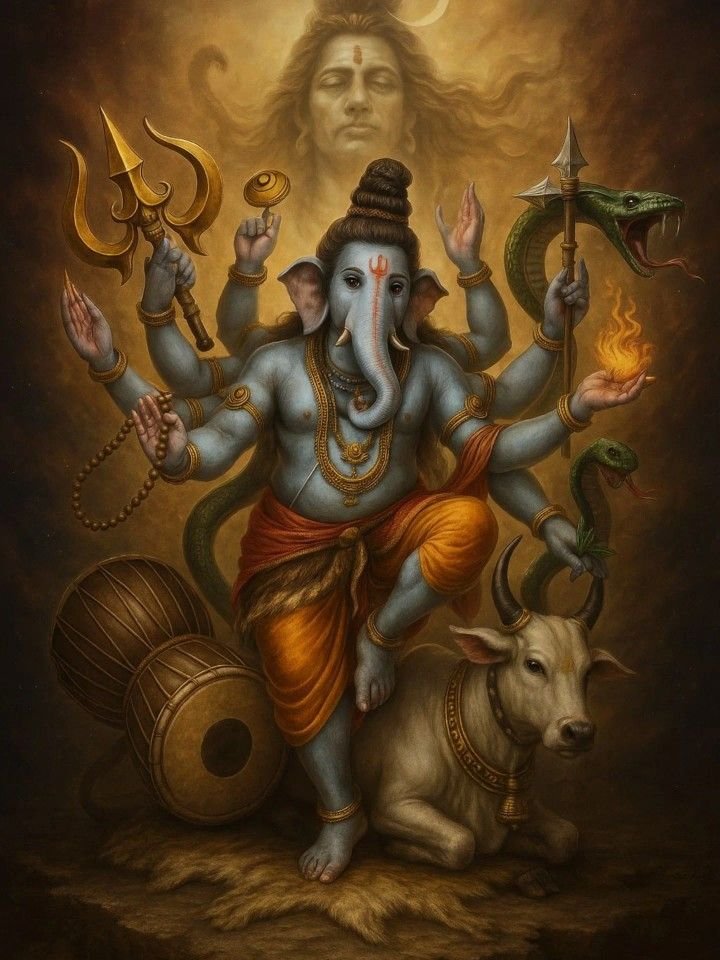
रक्ताभं घण्टा–निनद–सदृशं दीप्त–वक्त्रं त्रिनेत्रं
भ्रूक्षेपोत्थ–क्रोध–ज्वलन–मुकुटं सर्प–माला–विभूषम् ।
शूल–दण्ड–खट्वाङ्ग–कपाल–परशु–शक्ति–पाश–डमरु–हस्तं
वन्देऽहं गिरिश-अघोर-भावं गणेशम् ।।
This is the form of Aghora Ganapati..
Aghora Ganapati is seen in a reddish, glowing form, similar to the warm radiance rising from fire. His presence carries a resonance and depth comparable to the steady, powerful vibration of a temple bell. His face is bright and commanding, and he possesses three eyes, representing sharpened awareness and expanded perception.
The slight lift or movement of his eyebrows reflects a controlled and focused intensity, which appears as a subtle fiery radiance around his crown. He is adorned with serpent garlands.
Aghora Gaṇapati has eight hands, each holding a specific and traditional weapon:
Shula — the trident
Danda— the brahma-danda
Khatvanga— the skull-staff
Kapala— the skull
Parashu— the axe
Shakti— the spear
Pasha— the noose
Damaru— the drum
With these attributes, he expresses the Aghora-bhava of Shiva — the state where obstacles / enemies are removed at the root and awareness is sharpened. This form represents an extremely subtle energy, but brings a massive transformation.
MYTH vs TRUTH
Myth 1: Aghora Gaṇapati puja cannot be done at home.
Truth:
Aghora literally means the absence of ghora — not the presence of it.
People misunderstand Aghora because they look at Aghoris in Kashi, see their avadhuta behaviour, and assume that is what Aghora means. This is a modern confusion.
Aghora = a state free from fear, distortion, violence, and inner turbulence.
So Aghora literally means prashanti — the state where fear, agitation, violence, and inner disturbance are absent. It is a peaceful state, not a horrific one.
It is only because people see the infectious, extreme, socially detached Aghori groups in Kashi consuming dead meat, narcotics & what not — those whose conduct is far from the Shastric Aghora — that the meaning of “Aghora” has been distorted. The public sees their outward behaviour, ash-smeared bodies, and antinomian lifestyle and assumes:
Aghora = scary + taboo + cemetery rituals + danger.
**Therefore — Aghora is NOT a terrifying form.
Aghora is the destroyer of terror.**
Aghora is the absence of ghora, the end of fear, the dissolver of inner darkness, the light that burns confusion and heaviness.
This is why Aghora Gaṇapati is not a “scary” Ganesha.
He is the one who removes ghora, not the one who embodies it.
Not horrific.
Not terrifying.
Not chaotic.
Not anti-social.
The root meaning makes it unmistakably clear:
‘a’ = absence
‘ghora’ = fearful, terrible, agitating, mentally disturbing
Myth 2: Aghora Gaṇapati puja cannot be done at home.
Hope, with the above clarifications, you have the answer yourself for this digital myth.
Myth 3: Only sannyasis are allowed to worship Aghora Ganapati.
Truth:
Aghora Gaṇapati is not a devata limited to sannyasis, akhaḍas, or fringe practitioners.
This idea comes from modern misconceptions around the word Aghora, not from any Shastric foundation.
Aghora is a tattva, not a social identity.
It is a Shiva Bhava, not a dress code or eating corpses or getting intoxicated.
It is an inner state of clarity, stability, and fearlessness, not an external lifestyle of renunciation.
Therefore, any sincere practitioner — including householders — can worship Aghora Gaṇapati, provided you have the Correct paddhati.
“Correct Paddhati is required to do any japa or puja or havana for every form of supreme divine and this is not something peculiar to this form alone.”
Myth 4: Aghora Ganapati worship is only for Aghoris.
Truth:
This idea comes purely from modern internet storytelling.
Aghora Ganapati is NOT an Aghori–exclusive Swamy.
He is not a sectarian devata, nor is his worship confined to Kashi Aghoris, smashana traditions, or extreme ascetic groups. We are the living examples to break this myth.
Myth 5: Aghora Ganapati can be worshipped only in Vamachara.
Truth:
Most of these internet claims come from half-knowledge and the modern obsession with attaching “Vamachara” to anything that sounds intense, remains secretive from the texts.
But in reality:
Aghora IS NOT EXCLUSIVELY Vamachara.
Aghora IS NOT ‘EXCLUSIVELY left-hand’, taboo, or transgressive ritual.
Aghora = the state where ‘ghora’ (fear, agitation, confusion) is completely absent.
Both the right & the left hand practices has to be learnt from the learned people and not through text books. Even the fundamental understanding will go missing here.
Aghora Ganapati shall be worshipped under Shaivachara & Dakshinachara ONLY.
Myth 6: Aghora Ganapati is a fierce, monstrous form worshipped by Aghoris in a tantric way.
Truth:
This claim survives only because the modern internet has confused “Aghora” with “horror.”
Myth 7: Aghora Ganapati has a dark complexion, skull-garlands, tiger-skin, cremation-ground horror look.
Truth:
Aghora Gaṇapati is not dark in complexion – “RAKTAABHA” represents his reddish colour, not black, charcoal, or horror-themed.
The popular assumption that ‘Aghora’ means cremation-grounds is the root of this confusion. People project horror imagery onto Aghora forms, without understanding that Aghora actually means the absence of fear and disturbance.
Myth 8: Aghoris worship Aghora Ganapati to gain strength, fearlessness, and wisdom.
Truth:
This idea is completely incorrect because it is just an assumption that the Aghora Gaṇapati belongs exclusively to Aghoris and his worship is part of their lifestyle or their siddhi-seeking practices.
In reality, the majority of people popularly called “aghori” today work almost entirely with Shabara mantras only. Aghora Gaṇapati vidya, on the other hand, is rooted in legitimate Shastric lineage, grounded in proper mantra-shastra. Therefore, linking Him ONLY to modern aghori practices not only distorts the nature of Him & His vidya; but also disconnects Him from His authentic scriptural basis.
Myth 9: Aghora Ganapati sadhana involves red flowers, bilva leaves, and typical tantra offerings.
Truth:
Like other vidyas, Aghora Gaṇapati worship also does not follow the commercialized “tantra kit” logic found on the internet, where people casually attach:
red flowers,
red cloth,
bilva leaves,
lemon,
chillies,
wine-substitutes,
or items copied from unrelated tantra traditions.
These assumptions come from generic Vamachara stereotypes, not from the actual Agamic or traditional roots of Aghora Gaṇapati.
Myth 10: Aghora Ganapati worship grants inner peace, freedom from obstacles, and deep transformation, so it is common among Aghoris.
Truth:
Yes, Aghora Gaṇapati grants these results — but limiting this to Aghoris simply because His name contains ‘Aghora’ is an ignorant conclusion.
So, Aghora Gaṇapati is not a divine form of shock value, fringe asceticism, or internet fantasy.
He is a Shastrika, sacred, deeply traditional form of Gaṇesha rooted in the Aghora-bhava of Shiva — the state where fear dissolves, confusion ends, obstacles are burnt at their root, and clarity arises.
Most of the modern myths surrounding Him come from:
misunderstanding the word Aghora,
misinterpreting the behaviour of certain non-shastrika “aghori” groups,
projecting horror aesthetics onto sacred forms,
and lifting concepts from half-knowledge, sensational articles, and careless social-media content.
When we look at the actual dhyana, the lineage-based understanding, and the meaning of Aghora itself, one thing becomes absolutely clear:
Aghora is not darkness — it is the fire that removes darkness.
Aghora is not terror — it is the absence of terror.
Aghora is not taboo — it is transformative clarity.
Aghora Gaṇapati is thus neither a forbidden form of supreme divine nor an exclusive cult figure.
He is approachable to sincere seekers, including householders, when worshipped through proper paddhati, with humility, discipline, and authenticity — not through imagination or online distortions.
By returning to the original meaning of Aghora & the dhyana shloka of Aghora Ganapati mentioned above, the real purpose of this form, the noise of modern myths collapses instantly and what remains is the pure vidya:
Aghora Gaṇapati —
the subtle, radiant, transformative form of Gaṇesha
who removes fear, dissolves agitation, burns obstacles at the root, and steadies the seeker on the path of truth.
Additional Myth: “Even a minimal count of japa is enough to attract Aghora Gaṇapati’s attention.” — WRONG!!!!
This idea is yet another product of internet storytelling and YouTube mythology.
No devata appears or responds merely because someone performs a few casual repetitions of a mantra with no proper japa vidhi and Aghora Ganapati is no exception.
You shall click here to know how his mantra works.
To know the in-depth technical aspects of this Aghora Ganapati vidya, you shall click here.

- Guhya Kali and the Sacred Structure of Kali Tryara Puja - February 2, 2026
- Naga Dosha: The True Causes as Defined in Naga Vidya - January 8, 2026
- The Kalladikode Parampara of Chathan Swamy: Vishnumaya Chathan, Karimkutti Chathan, and the Original Lineage Explained – Part 2 - December 22, 2025
