
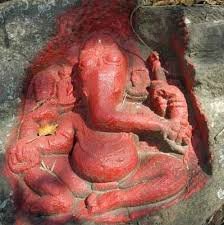
The idea that Aghora Ganapati must be worshipped only in cremation grounds is yet another creation of studio spirituality and social-media fantasy.
In authentic vidya-parampara, even Aghora Ganapati is seated on kamalasana only, not on pretasana.
Aghora Ganapati is approached only through two acharas:
Shaivachara and Dakshinachara.
There is no Vamachara here — because the very nature of this form does not align with that path.
Why?
Because Aghora Ganapati is the astra-swarupa & not ananda-swarupa…
He is not the humongous, terrifying figure that modern people speak or write.
He is atomic in size, subtle, concentrated — yet carries an immense destructive force, as he is a divine weapon.
A weapon has only two functions:
to protect and to destroy.
Both are inseparable.
- Mantras with Rajasika Guna protect without harming the opposing force.
- Mantras with Tamasika Guna protect by neutralizing or destroying what threatens the bhakta.
Aghora Ganapati mantra works in the principle of Tamasika Guna mantras.
When you seek his protection, he does not simply “cover” you.
He asks:
“From what or from whom do you require protection?”
And that very obstacle — whether external or internal — gets dismantled so that you remain safe.
With Aghora Ganapati, it is not only the disturbances created by enemies that get cleared, and not only the enemies themselves who face destruction. His force goes far beyond that. Aghora Ganapati’s mantra carries the ability to cut, dissolve, and uproot anything that threatens the well-being of the seeker — whether that threat comes from outside or from within the body.
Just as he destroys harmful forces, he can also strike at the root of diseases, weaknesses, and hidden disorders that hold a person back. His mantra works like a precise weapon:
removing the cause, clearing the obstruction, and restoring balance.
For this reason, Aghora Ganapati is known not only for protection, but also for healing, because both protection and curing are part of the same weapon-principle — removing what harms, and strengthening what must remain.
Aghora Ganapati is surrounded by four other forms of Ganapati: Vakratunda Ganapati, Mahodara Ganapati, Uddanda Ganapati, and Vikata Ganapati. These four forms act as the protective circle around Aghora Ganapati and support the working of his weapon-form force.
And because Aghora Ganapati carries within him the destructive force of the Sadashiva, he is never left unsupported in that function. The force he holds is not ordinary; it is sharp, decisive, and capable of cutting through layers of seen & unseen enmity. To stabilize and channel this power, five Vetalas stand with him as his constant assistants.
These five Vetalas are:
- Hayasya Vetala
- Ushtravaktra Vetala
- Vahnivaktra Vetala
- Vyalasya Vetala
- Makarasya Vetala
These five vetalas do not act independently; they operate only under the command of Aghora Ganapati, ensuring that his destructive force remains controlled, precise, and aligned with dharma.
This entire structure shows how powerful — and how carefully managed — the Aghora Ganapati system truly is. It is not chaos as getting preached everywhere without any base.
Apart from these Vetalas, there are sixteen forms of Ganapati who hold and maintain the principle of Ganapatyam within the Aghora system. These forms are not random variations; they are the foundational expressions through which the power, order, and discipline of Ganapati are sustained inside the Aghora vidya. Each form anchors one aspect of stability, creation, protection, or controlled destruction.
The sixteen forms are:
- Rudra Ganapati
- Shankara Ganapati
- Shrushti Ganapati
- Sthiti Ganapati
- Samhara Ganapati
- Pinaki Ganapati
- Mrtyu Ganapati
- Kalyana Ganapati
- Ksiti Ganapati
- Bhava Ganapati
- Agni Ganapati
- Ugra Ganapati
- Bheema Ganapati
- Vishveshwara Ganapati
- Ishana Ganapati
- Maha Ganapati
These sixteen forms together create the inner mandala around Aghora Ganapati, ensuring that his weapon-force of Aghora astra remains connected to the broader order of Ganapatyam.
Along with these forms, there are also six forms of Bhairava who support and fortify this weapon-form of Ganapati. These Bhairavas do not act separately; they stand as the fierce guardians who hold the outer perimeter of the Aghora field, ensuring that the destructive force of Aghora Ganapati remains steady..
These six Bhairavas are:
- Samhara Bhairava
- Rudra Bhairava
- Unmatta Bhairava
- Samaranda Bhairava
- Karala Bhairava
- Vikarala Bhairava
Their presence around Aghora Ganapati shows that this form is not a simple or isolated expression of Ganapati. It is a highly guarded, tightly structured system where Shaiva forces, Ganapati forms, Vetalas, and Bhairavas all align to maintain the precision and stability of the Aghora tattva of Sadashiva.
The outermost protection of this astra is held by four powerful guardians, each belonging to the highest Shaiva order. Their presence shows how serious, controlled, and highly protected this entire system is.
These four guardians are:
- Nandi – the eternal gatekeeper of Shiva, who anchors stability and discipline around the astra.
- Vira Rudra – the fierce warrior-form of Rudra who ensures that no hostile force crosses into the field of the weapon.
- Vatuka Bhairava – the youthful, sharp, and alert guardian who cuts through subtle disturbances and psychic interferences.
- Kalagni Rudra – the fire of time itself, who burns anything that attempts to approach the astra with impurity or aggression.
When these four stand as the outer guardians, it shows one thing clearly:
Aghora Ganapati is a sacred weapon of clarity, healing, and removal of suffering, aligned directly with the highest principle of Shiva.
His entire system exists not to frighten, but to protect, uplift, and restore balance in the lives of those who approach with sincerity.
To learn more about Aghora Ganapati, you shall click here.
To learn about the Myth Vs Truth about the vidya of Aghora Ganapati, you shall click here.

- Guhya Kali and the Sacred Structure of Kali Tryara Puja - February 2, 2026
- Naga Dosha: The True Causes as Defined in Naga Vidya - January 8, 2026
- The Kalladikode Parampara of Chathan Swamy: Vishnumaya Chathan, Karimkutti Chathan, and the Original Lineage Explained – Part 2 - December 22, 2025
