
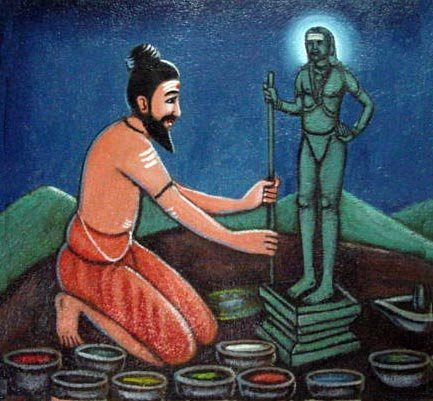
Bhogar wandered through the streets, his hair matted and unkempt, his body unwashed, wearing only a simple loincloth. His tongue had dried from thirst. When he saw a group of Brahmins reciting the Vedas, he approached them and politely asked for a little water to drink.
But the Brahmins, seeing his disheveled appearance and unclean body, turned away in disgust.
“How dare you come near us in such a state? Go away, you filthy man!” they shouted.
Bhogar stood silently, saddened by their words. They had judged him by his outward form, unable to see what he truly was.
Without a word, he picked up a cat that was wandering nearby. Holding it close, he whispered something softly into its ear. A moment later, the cat jumped onto the veranda and began reciting the Vedas — perfectly, in clear and resonant tones.
The Brahmins were stunned. Their arrogance vanished in an instant. Realizing their mistake, they fell at Bhogar’s feet, tears flowing, and begged for forgiveness.
Bhogar forgave them without anger.
One of the Brahmins said, “Swami, now we understand that you are Bhogar Siddhar, the one who holds supreme powers. To have your feet touch this street must be our great fortune. Swami, we are suffering from terrible poverty and are facing death because of it. We keep chanting the Vedas day and night only to forget our pain.
A gentle smile appeared on Bhogar’s lips.
He thought to himself — How small death has made man become!
Human beings live fearing that slow, creeping shadow that hides and slithers quietly through life — and when it finally appears in full form, they tremble at its monstrous face.
But Bhogar was not one who feared death.
He was the Siddha who had discovered the art of deathlessness — the science of transforming decay into light.
Can death be conquered?
The Siddhas said, “Yes.”
The madmen said, “No.”
The Brahmins, still kneeling, pleaded with him:
“Swami, please save us from our suffering. End our poverty and give us life again.”
Bhogar looked at them with compassion and said,
“So be it. Bring to me all the vessels made of metal from your homes.”
At once, the Brahmins ran to fetch every metal vessel they owned — copper, brass, and bronze — hearts trembling in anticipation, for they sensed that something wondrous was about to happen.
Bhogar Siddhar arranged layers of firewood around the metal vessels and lit them. The flames rose steadily, burning with the red glow of molten heat. As the metals began to soften and glow like embers, Bhogar took a small vial that hung from his waist — it contained the Adhi Rasa, the primal elixir he had prepared through long tapas.
He opened it carefully and sprinkled a few drops over the heated vessels.
In an instant, a wonder occurred.
Before the eyes of all those gathered, the vessels began to shimmer and transform — the dull metal surfaces brightened, deepened, and turned into pure gold.
The Brahmins were overcome with joy. They danced and shouted with disbelief and delight, their faces glowing in the reflection of the new gold.
Bhogar watched them quietly. Seeing the happiness that had replaced their suffering, he simply smiled. Then, without attachment, he handed all the gold to them and left the place, walking away as calmly as he had arrived.
Yet, in his heart, another thought was stirring.
This Adhi Rasa that holds such power, he thought, should not remain with me alone. The other Siddhas too must use it for the welfare of the world.
As he reflected thus, Bhogar took one of his rasa kulikai and placed it in his mouth, keeping another in his hand. Then, rising from the earth through the force of his siddhi, he soared into the sky — moving toward the distant land of Rome, where he sought the rare substance that would perfect his alchemical creation.
Crossing the southern seas, Bhogar flew through the skies towards Rome. In the southern edge of Rome, he perceived the place where the well of Adhi Rasa was hidden.
Bhogar was no stranger to death — he had already conquered it. He knew well that the Adhi Rasa drawn from that well possessed unimaginable powers, capable of granting siddhis beyond measure.
As he hovered in the sky, he saw that the rakshasas were guarding the well, both day and night, under the command of Shiva himself. This was to ensure that no wandering Siddha from the higher planes would steal even a drop of that sacred essence.
Using the power of his rasa kulikai, Bhogar rendered himself invisible to their sight. Then, holding a small coconut shell in his hand, he descended quietly toward the well to collect a little of the Adhi Rasa.
But as he lowered the shell, the rasa began to move away from it — as though alive, retreating from his grasp. Bhogar understood that this was no ordinary substance; it was aware, conscious, unwilling to be taken without divine sanction.
He immediately sat in meditation and invoked Ambikai, the Mother. In deep stillness, her command came to him.
Obeying her inner instruction, Bhogar then prayed to Shiva and uttered the stambhana mantra — the mantra of stilling and binding. At once, the moving rasa became motionless.
He filled his coconut shell with the now-stilled Adhi Rasa and rose again into the sky, flying swiftly back through the ether, carrying within that small vessel a force capable of transforming the very destiny of the world.
As Bhogar flew through the sky carrying the Adhi Rasa, the rakshasas who stood guard in the ether saw him and blocked him.
Would he surrender before their might?
Would he fight them with the fire of his siddhi?
Or would he dissolve into the very air, unseen by gods and demons alike?
we shall see in the next chapter.

- Guhya Kali and the Sacred Structure of Kali Tryara Puja - February 2, 2026
- Naga Dosha: The True Causes as Defined in Naga Vidya - January 8, 2026
- The Kalladikode Parampara of Chathan Swamy: Vishnumaya Chathan, Karimkutti Chathan, and the Original Lineage Explained – Part 2 - December 22, 2025
