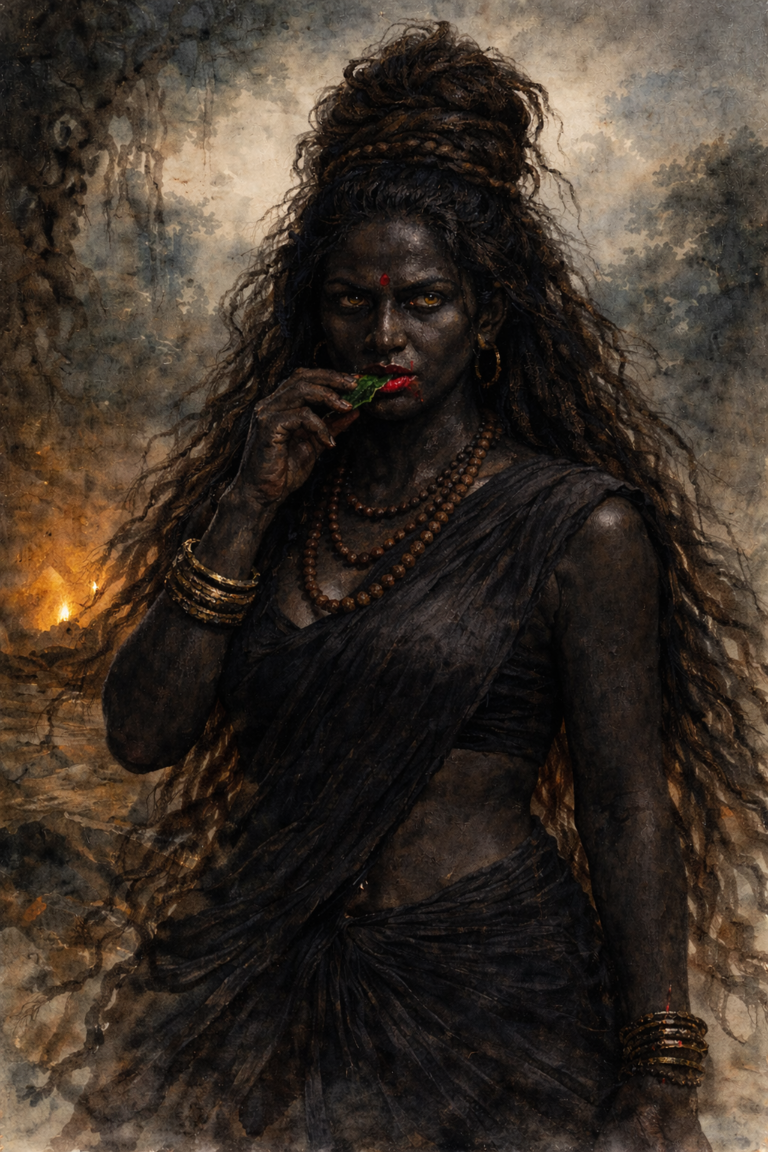
In the deep folk–mantric memory of Kerala, Ottamulachi is not remembered as an ordinary yakshi born of fleeting desire or accidental death. She is known as a Brahma Yakshi — a far rarer and more dangerous category of being, shaped by intense inner power, unresolved karma, and a violent rupture from embodied life.
She stands outside temple traditions and devotional frameworks. Her presence belongs to forests, cremation grounds, abandoned paths, and liminal spaces, where the boundaries between the living and the unseen dissolve. Ottamulachi is not approached for grace or comfort; she is acknowledged, feared, and ritually settled, in accordance with ancient folk discipline.
Traditional accounts recognise her as the sister of Karinkutti Chathan, not merely in narrative terms, but as a being arising from the same wild shakti stream and she always accompanies Karinkutti Chathan.
Even when the prayoga is done, she will go along with Karinkutti Chathan to hurt our enemies.
Together, they represent forces that operate beyond social order and human morality — energies that respond only to boundary, authority, and correct ritual containment.
Ottamulachi’s form is remembered as asymmetrical, with only one breast, a feature that has often been misunderstood by those outside the folk–tantric worldview. In traditional understanding, this is not a mark of loss or mutilation, but a sign that her motherhood does not follow ordinary human patterns.
Even with a single breast, Ottamulachi carries ugra matr-shakti — a form of motherhood that is fierce, selective, and bound by strict maryada. Her nourishment is not freely given, nor is it indiscriminate. It flows only toward those who approach her with fear, discipline, and proper recognition.
This form reminds us that motherhood itself is not always gentle. In certain shakti manifestations, it is protective through terror, sustaining through severity, and corrective through fear. Ottamulachi’s single breast thus signifies concentrated maternal power, not absence — motherhood that has turned inward, intense, and uncompromising.
For those who worship her in the manner meant for her, within boundary and restraint, she is believed to withhold destruction and grant protection, containing harm rather than releasing it. Her motherhood does not comfort — it guards.
Ottamulachi is traditionally described as appearing like a human tribal woman, often around middle age. Her appearance is not divine in a temple sense, yet her presence is unmistakably inhuman and overwhelming.
She is remembered as:
Dark in complexion, blending into night and shadow
Wearing a simple black saree, rooted in local, earth-bound identity
Bearing matted locks (jadamakuta), unbound and wild
Carrying herself with authority, not haste
Constantly chewing paan (beeda), her lips stained red — a sign of restless hunger and unbroken attachment to the earthly plane
The chewing of paan is not a casual habit. In folk understanding, it reflects her unceasing inner agitation, a mind that never settles, a hunger that never resolves.
As a Brahma Yakshi, Ottamulachi’s desire is not romantic or sensual in the human sense. Traditional belief holds that she is drawn to the blood and vitality of young men, not for pleasure, but for life-force (praṇa).
This hunger is predatory, instinctual, and consuming, not erotic.
Ottamulachi is feared not because she is cruel, but because she is indifferent to human comfort. She does not respond to casual prayer, emotional appeal, or devotional sentiment.
Older generations avoided speaking her name lightly. Certain paths were not crossed after dusk. Young men were warned to remain disciplined. These were not superstitions, but protective measures shaped by lived experience.
She was never worshipped in the conventional sense. She was acknowledged, pacified, and ritually contained when her influence became evident.
Ottamulachi stands as a reminder that not all shaktis exist to bless, uplift, or console. Some exist to test boundaries, expose arrogance, and enforce unseen laws that govern wild and untamed power.
To recognise Ottamulachi is not to glorify fear —
it is to respect forces that lie beyond human domestication.
Last, but not the least – She falls under the gana of Kali..