Pulluvar Community & Nagas With Garuda
The Pulluvar are a traditional community of Kerala in which the men are called Pulluvan and the women are called Pulluvathi. They are traditionally known as musicians and ritual specialists, and are officially listed among the Scheduled Castes of Kerala.
Their traditional ritual practice is primarily expressed through music.
The Pulluvar are not merely ritualists. They are also known for their knowledge of astrology and traditional herbal medicine, and they have a particularly strong association with Naga rituals and the worship of serpent deities.
The word “pullu” denotes a hawk or bird, which is traditionally associated with the community’s practices of divination.
In one of our Facebook posts or earlier blog articles—we cannot recollect which one—we mentioned that Garuda and the Nagas are portrayed as enemies in various tales and texts. Yet, when we enter the deeper sphere of Mantra-Tantra Shastra, the two are not merely enemies; they are interlinked with one another.
In this sense, it is almost as though Garuda places his ornaments before us, allowing us to perceive the mystery of the Nagas through the songs that the Pulluvar sing with uttermost devotion.
The Pulluvar do not worship Nagas exclusively. Their traditional religious world also includes Skanda, Ayyappa, Rahu, Muni, Chathan, Mukkan Chathan, Karinkutti Chathan, Parakkutti Chathan, Bhadrakali, and other deities and spiritual beings.
Thus, reducing the Pulluvar simply to “snake worshippers” would actually distort their older religious profile.
Pulluvan Rituals and the Trance of Sarpam Thullal
The Pulluvar songs itself contains a developed serpent mythology. Their songs refer to Kadru and Vinata, the genealogy of the Nagas, the Ashta Naga tradition, and mythological episodes involving Garuda and the serpents.
This is significant because it shows that Pulluvar Naga rituals are not merely expressions of a generic fear of snakes. They possess an elaborate mythological and ritual vocabulary surrounding the Nagas.
They have their own Ashta Naga Stuti, consisting of songs addressed to the Ashta Nagas, which is a distinctive feature of their traditional repertoire.
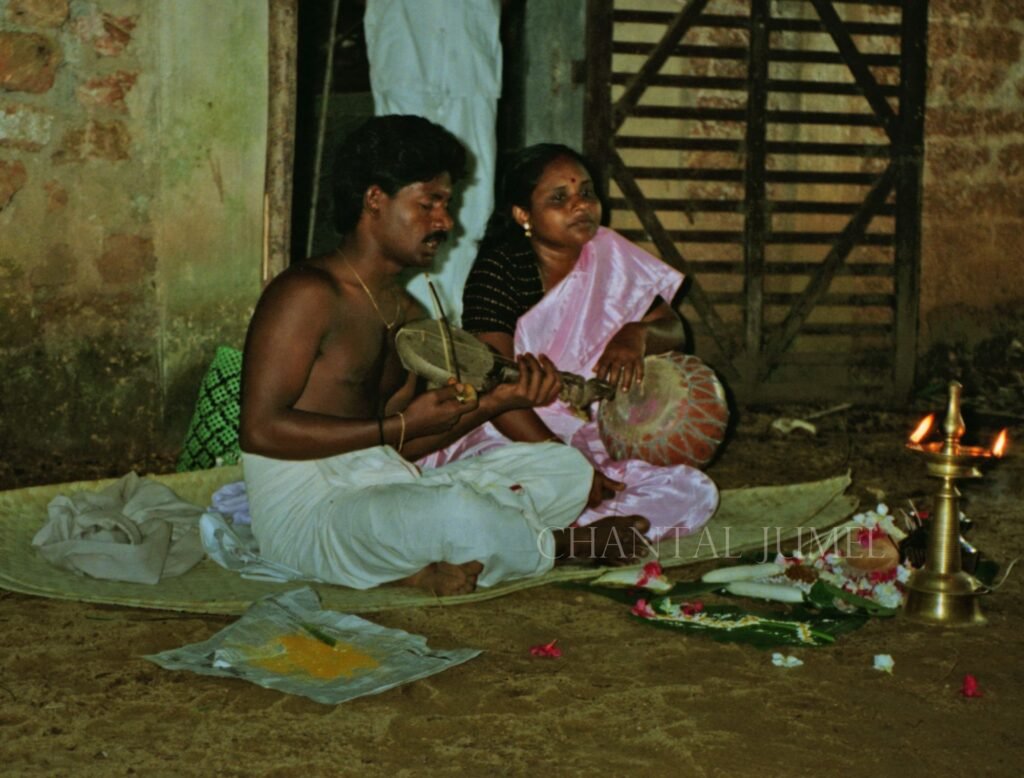
They use the Pulluvan Veena as their primary instrument. It is a simple one-stringed instrument. The Pulluvar regard the Pulluvan Veena as being no different from Shiva himself: the kudam portion is considered as Brahma, while the music emerging from it is considered as Vishnu. Also, they use Pulluvan Kudam.
Their songs—Pulluvan Pattu, also called Sarpam Pattu or Nagam Pattu—are not mere performances. They are invitations.
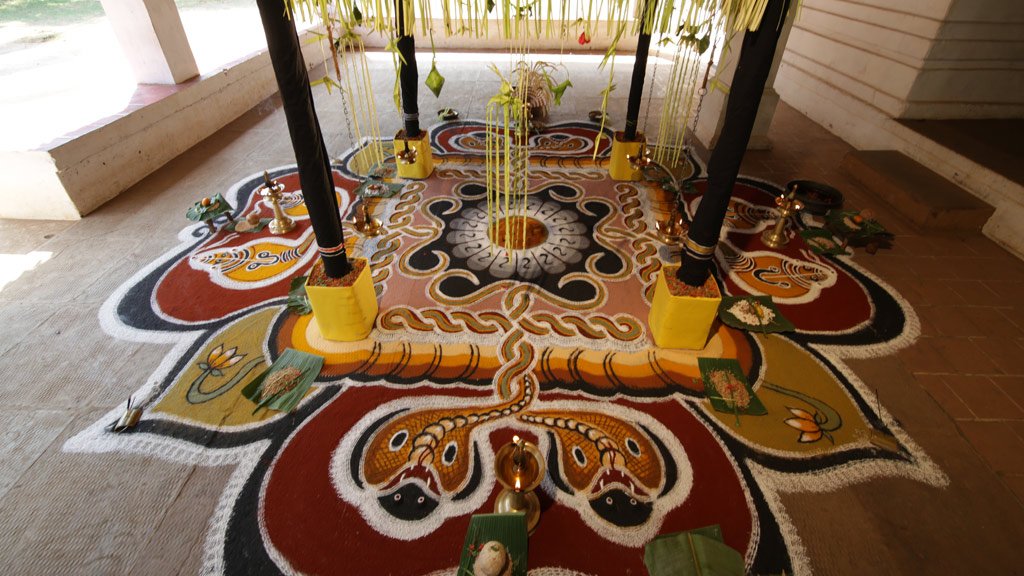
Through music, Kalamezhuthal, and carefully orchestrated ritual, they open a doorway between the human world and the realm of the Nagas.
The Ritual Framework of Naga Rituals
A full Sarpam Thullal, meaning the “dance of the snakes,” is also known as Nagakalam Pattu or Pambum Thullal. It is usually commissioned by a family to propitiate serpent deities, remove Naga Dosham, seek fertility, prosperity or healing, or fulfil a vow.
The ritual may last for one night or extend across several days, sometimes from three to twelve days. Its preparation includes austerities, with participants and hosts observing dietary restrictions and rules of ritual purity.
The Pulluvan Pattu That Calls the Serpents
The Pulluvan and Pulluvathi sit beside the Sarpa Kalam. They play melodies using the Pulluvan Veena.
Their songs begin with invocations to Ganesha and other deities, and then move towards the praise of the Nagas, including Maninagam, Karinagam, Kuzhinagam and Paranagam, along with Naga Yakshi and Naga Chamunda.
The music itself is said to attract the serpents. Its rising and falling notes mimic their movement.
This is one of the most fascinating aspects of Naga Vidya as preserved through the Pulluvar tradition: the serpent is not merely spoken about or represented. It is approached through sound, rhythm, form and ritual movement.
The Descent into Trance
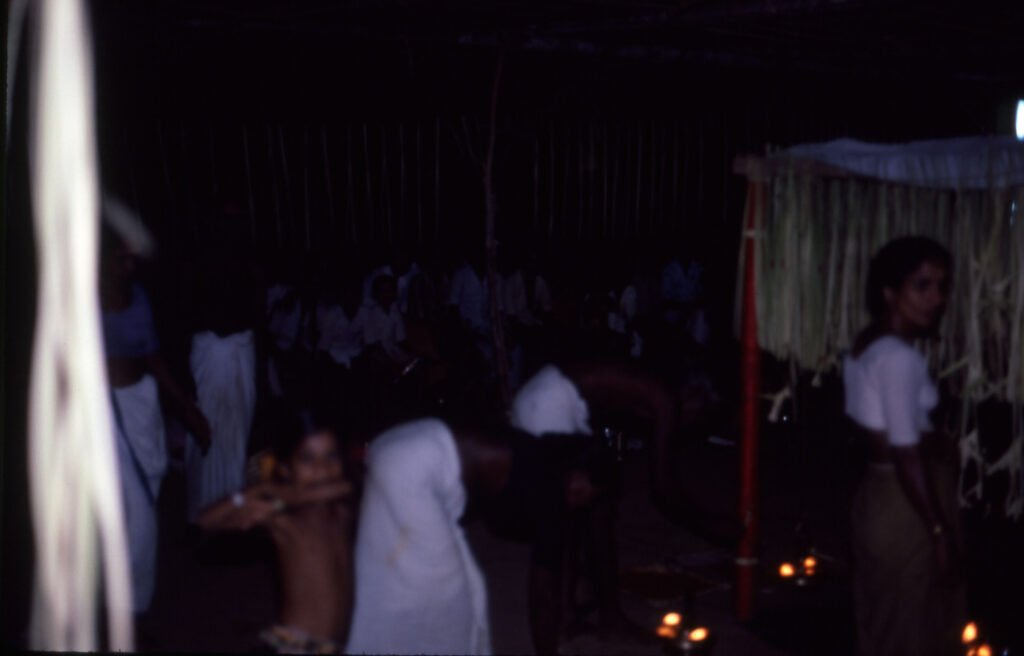
Young women or girls—often pre-pubescent or carefully prepared members of the host family, sometimes called Kanyas or Piniyals—sit or stand near the Kalam, usually holding bunches of tender areca-nut flowers (pookkula).
The fragrance of the flowers, the hypnotic music, the heat of the lamps and the charged ritual atmosphere work together.
Within approximately 20–30 minutes, the shift begins.
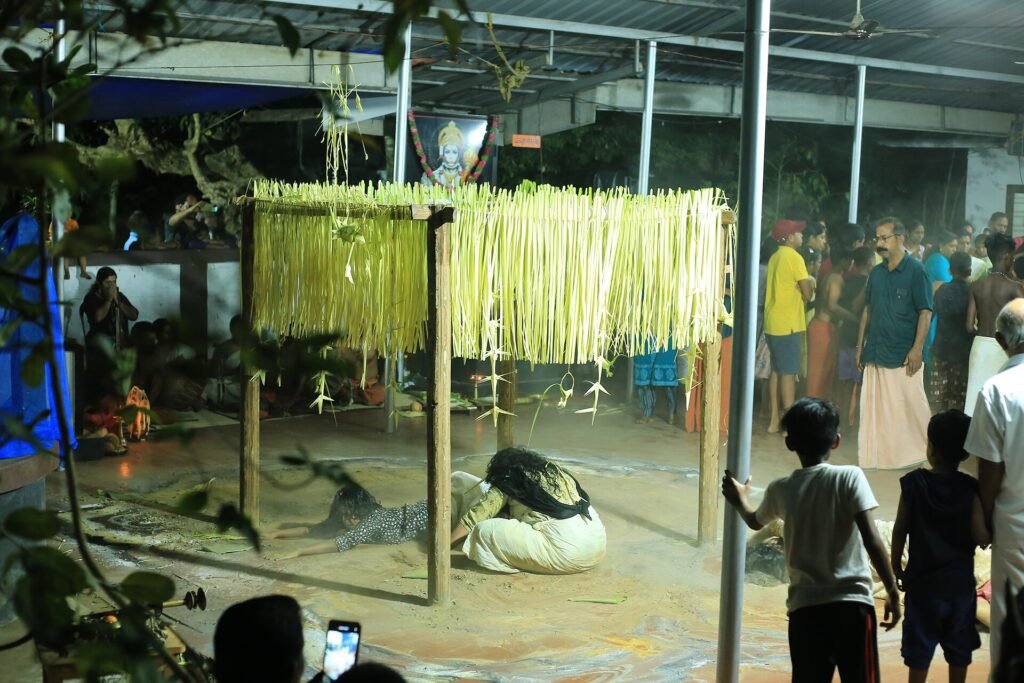
Bodies start to sway. Breathing changes. Movements become increasingly undulating and serpentine—slow at first, then intensifying into hopping, rolling, hair-swinging and rhythmic thrashing.
Participants later describe feeling the drawn snake come alive, sensing vibrations travelling through the body, or experiencing the deity entering through the senses—the nose, mouth, eyes and ears.
This is the Thullal: the possession trance.
In this state, the mediums are no longer ordinary people. They embody the Naga.
They may deliver oracles—answers to family questions, warnings, blessings or instructions for further rituals.
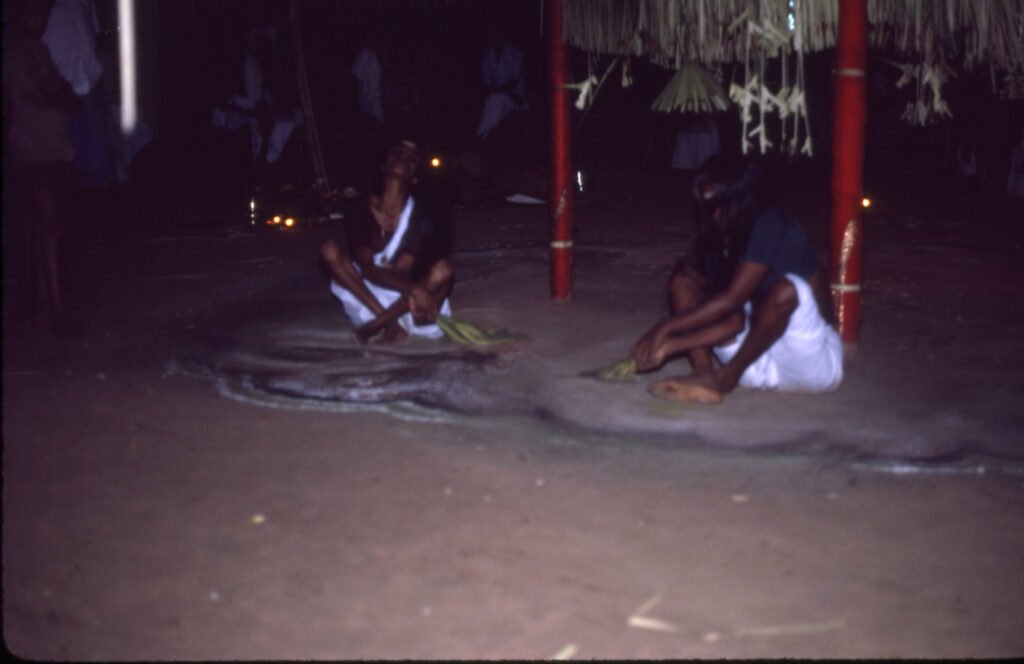
The climax arrives with Kalam Mayikkal. The entranced dancers use their bodies, hair or the areca flowers to erase the floor drawing completely.
The destruction of the Kalam is the moment of release and acceptance. The deity has been fed, heard and allowed to return.
The mediums often collapse afterwards and are carried away.
Deeper Layers of the Pulluvar Tradition
Pulluvans hold specialized knowledge and power within the sacred space, yet historically occupy a lower social position outside it.
Women—especially the young mediums—occupy the central transformative role. Their bodies become the site where divine force, Shakti, crosses into the human world.
The performance itself is a carefully held liminal space. Everyday social rules loosen, suppressed emotions can surface, and the family receives direct communication from the serpent realm.
This dimension of the ritual is particularly important when examining Naga rituals and Naga Vidya beyond their external forms. The music, the Kalam, the ritual participants, the serpent imagery and the trance are not isolated components. They function together within a single ritual framework.
The Continuity of Naga Rituals
Today, full Sarpam Thullal events have become rarer as sacred groves disappear and lifestyles change. Yet the Pulluvan tradition persists.
Some families still commission multi-day performances. Pulluvan singers continue to perform shorter invocations at temples and homes, especially on Ayilyam days.
A few dedicated practitioners actively teach the songs, instrument-making and Kalam drawing so that this knowledge does not disappear.
What remains most compelling is the living threshold that the ritual creates.
The music does not merely describe the serpent—it invites it.
The Kalam does not merely depict the serpent—it becomes its temporary body.
And in the trance, the boundary between human and divine briefly dissolves into pure movement, prophecy and release.
This is what makes the Pulluvar tradition such an important subject for anyone seeking to understand Naga Vidya, Naga rituals, Naga mantra traditions, serpent worship and the ritual phenomenon of trance in Kerala.
To know The 64 Varieties of Nagas and the 8 Principal Nagas (Ashta Nagas): Traditional Knowledge and Characteristics – you shall click here.
To know about the glimpse of Naga rituals, you shall click here.
To know about the profound link between Ashta Nagas, Navagrahas and Garudi vidya, you shall click here.
To know about Naga Dosha, its true causes as per Naga Vidya, you shall click here.
To learn a powerful Naga Shanti Storam, you shall click here.

- The 9 Enemies of Human Life and How Maa Dhumavati Destroys Them: The Secret of Nava Shatru Shamana - October 7, 2026
- Introduction to tripurA rahasyam – part – 4 – sukha vs duHkha - September 21, 2026
- Aghora Ganapati: An In-Depth Technical Study of His Vidya, Forces, and Guardians - September 21, 2026

Namaskaram Guruji,
Thank you for sharing this deep rooted traditional information about the Naga rituals.