
It is said that the name Kubjika originates from the word Kubja.
And so, Kubjika is understood as the hunchbacked Goddess. But if she is hunchbacked, why do traditional paintings not portray her as a hunchbacked woman?
The truth is that Kubja means crooked.
Anything that goes against the natural order is considered “crooked”.
As per my Darshana, I once asked my Maharaj:
“Maharaj! I saw a little girl walking upside down somewhere in a temple, in the Rajasthan style.”
Immediately, he replied, “She is Kubjika, and she is showing you that your Muladhara is not awakened.”
[As I am on this path, I do not believe in these Kundalini stories about people claiming that their Muladhara is awakened or that their Kundalini has reached Ajna. In fact, I cut off contact with such people once and for all, as they deceive themselves as well as others.]
Coming to the point, I asked my Maharaj, “Who is she?”
He said that she is the hunchbacked Goddess and that she is rooted in our Kundalini.
However, somehow, I could not agree with the idea of her being hunchbacked. I continued walking this path of hers, and again and again, I used to see her as a girl walking upside down, meaning that she was walking on her hands with her legs pointing towards the sky.
Then, I checked all the possible meanings of the word Kubjika in Sanskrit dictionaries. Among all the meanings, one dictionary gave the meaning of Kubjika as an eight-year-old girl.
And when I started linking her with Kundalini Vidya, I began to understand a great deal about her. Here, a great deal should be understood as a grain of sand. Even a grain of sand carries some value when compared to nothing.
Let us dive a little deeper into the Sagara of Kubjika.
Kubjika can be worshipped exclusively under Shakta Mata, and she should be worshipped as Kubjika Mata, but along with Kubjeshwarar.
Out of all the Acharas, she can be reached only through Kaulachara.
[And once again, for the religious perverts, Kaulachara does not give anyone a free licence to drink and mate with women while smoking weed.]
As she is crooked and goes against nature, she is also called Vakrika.
She has the colour of the cannabis flower, and her Mandala is known as the Samvarta Mandala, the Mandala of cosmic dissolution.
See, when Kundalini is awakened, you will be put into the furnace. At some point, your body will dissolve into your Atma, and then your Atma will dissolve into Antaratma. Finally, your Antaratma will dissolve into Paramatma.
[So, never bring Western, resort-oriented or internet-manifested Kundalini dramas into your life.
These are real. Put in the effort and attain them. You do not need to imagine them as though they are something unavailable to men, where imagination is the only possibility.]
She expands herself into 32 Shaktis, out of which two are given below:
- Shukra Devi – The Goddess of Sperms.
- Bindu Pushpa – Here, Bindu is nothing but a drop of semen, or a seed of creation containing concentrated potency. Pushpa is nothing but the sexual organ of a woman. Here, Bindu Pushpa means the one who bleeds semen, i.e., one whose menses is not blood but semen.
This is the reason she does not want Kubjeshwara to create anything. She can create on her own.
CROOKED, SHE IS! ISN’T IT?
She reverses the order of nature.
Her Pitham is Oddiyana Pitham, surrounded by Purnagiri Pitham on the left, Jalandhara Pitham on the right and Kamarupa Pitham in front.
As she is verily the Kundalini Swarupa, she wears garlands and ornaments made of snakes.
n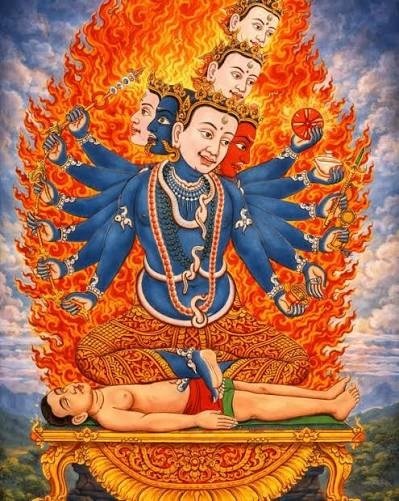
Her Dhyana Shloka
निलोत्पलदलश्यामा षड्वक्त्रा षड्प्रकारिका |
चिच्छक्तिर अष्टादशख्या बाहुद्वादश संयुता ||
सिंहासन सुखासीना प्रेत पद्मोपरिस्थिता |
कुलकोटि सहस्राढ्या कर्कोटको मेखलास्थित: ||
तक्षकेणोपरिष्टाच्चकले हारश्च वासुकि: |
कुलिक कर्णयोर्यस्या: कूर्मे कुण्डलमण्डल: ||
भ्रुवो पद्मो महापद्मो वामेनाग: कपालक: |
अक्षसूत्रं च खड्वाङ्गम् शङ्खं पुस्तकं च दक्षिणे ||
त्रिशूलं दर्पणं खड्गं रत्मालाङ्कुशम् धनु: |
श्वेतमूर्ध मुखं देव्या ऊर्ध्वश्वेतम् तथाऽपरम् ||
पूर्वास्यं पाण्डुरं क्रोधि दक्षिणं कृष्णवर्णकम् |
हिमकुन्देन्दुभं सौम्यं ब्रह्मा पादतले स्थित: ||
विष्णुस्तु जघणे रुद्रो हृदि कण्ठे तथेश्वर: |
सदाशिवो ललाटे स्याच्छि वस्तस्योर्धवत: स्थित: ||
She is dark-complexioned like the petal of a blue lotus, has six faces and is endowed with six distinct manifestations.
She is the Chitshakti, known by eighteen names, and possessed of twelve arms.
She is comfortably seated upon a lion-throne, situated above a lotus supported by a Preta (corpse-spirit).
She is adorned with thousands upon thousands of Kulas. Karkotaka is situated as her girdle.
Takshaka is positioned above her, while Vasuki forms her garland.
Kulika adorns her ears, and Kurma forms the circular arrangement of her earrings.
Padma and Mahapadma are positioned at her eyebrows, while on her left side is the serpent Kapalaka.
In her right hands, she holds the rosary, the Khatvanga (skull-topped staff), the conch and the sacred book.
She holds the trident, the mirror, the sword, the jewel-garland, the goad and the bow.
The face of the Goddess is white at the crown; another part above is likewise white.
Her eastern face is pale, her southern face is black and wrathful, while her gentle face shines like snow, jasmine and the moon.
Brahma is situated beneath her feet.
Vishnu is situated at her thighs, Rudra at her heart, and Ishvara at her throat.
Sadashiva is situated at her forehead, while Shiva is positioned above him.
Her Nyasams include 50 Rudras and 50 Rudra Shaktis.
Her main Nyasam resides in the Linga, as she resides in the middle of the six parts of the Linga as Vakrika.
And those six parts of the Linga are the seats of Tripura, Poorneshi, Nisheshi, Kubjika, Guhyakali, Siddhilakshmi, Dakshinakali and Vajrayogini.
Either she remains as Vakrika when he is alone, or, when he is with a woman, she resides with his Shiva. At that time, they both become Hatakeshwara and Hatakeshwari, with the woman.
This is from her Vamachara Puja Paddhati.
Here, one must ***** his Linga into the cavity of the Yoni. It is this particular form of indulgence that makes a man and woman remain in coitus even for three hours or more.
I do not merely speak about the text. This is where supreme bliss arises and ignorance is burnt.
Such a Linga is called the Kuleshwara Linga.
These six parts of the Linga are called the six Kausikas. The Linga is also called Shanmukha. Rudra becomes associated with the six parts of the Linga.
Places for Kubjika Sadhana
Kubjika’s Sadhana can be performed in the following places:
- Cremation ground
- Forest
- Near a well
- Garden
- Temple
- Empty house
- Royal palace
- Mountain summit
- Crossroads
- Village at a three-way junction
- On the roads
- Seashore
- River confluence
- Riverbanks
- Where there is a single tree
- Ekalinga Kshetra
Her entire Vidya lies in these five syllables.
Kubjika Under Different Vidyas
Under Shri Vidya
Under Shri Vidya, Atharvana Kubjika is worshipped as the Pashchimamnaya Vidhyeshwari.
Under Kubjika Vidya
Under Kubjika Vidya, eight forms are worshipped. They are:
- Rudra Kubjika
- Maha Kubjika
- Vira Kubjika
- Shmashana Kubjika
- Guhya Kubjika
- Siddhi Kubjika
- Bhima Kubjika
- Bhadra Kubjika
Under Kali Vidya
Under Kali Vidya, nine forms are worshipped. They are:
- Vajra Kubjika
- Shri Kubjika
- Samaya Kubjika
- Kubjika
- Moksha Kubjika
- Bhoga Kubjika
- Siddhi Kubjika
- Avesha Kubjika
Here, apart from all these forms, even Aghoreshwari, who is with Svacchanda Bhairavar, is also Kubjika alone.
Malini, Siddha Yogini, Kalika, Kula Yogeshwari, Carcika and Kubjika are her sixfold Shaktis.
She is closely linked to the number 32.
This Kubjika has another name: Dushta Chandalika.
This one Amba, Kubjika, becomes Iccha, Kriya and also Gnana.
She also becomes Ghora, Aghora and Ghoraghoratara.
When she is Para, she is worshipped with a one-syllabled Mantra, and she encompasses Iccha Shakti and Aghora Swarupa.
When she is Apara, she is worshipped with a six-syllabled Mantra, and she encompasses Kriya Shakti and Ghoraghoratara Swarupa.
When she is Paratpara, she is worshipped with the forty-three-syllabled Mantra, and she encompasses Gnana Shakti and Ghora Swarupa.
Thus, Kubjika is one Shakti who is no different from Lalita, Kali or Chandika. She can create, preserve and dissolve at her own will.
Frequently Asked Questions (FAQ)
Who is Goddess Kubjika in Tantra?
Goddess Kubjika (also known as Vakrika and Dushta Chandalika) is the supreme esoteric deity presiding over the Western tradition (Pashchimamnaya) of Kaulachara. She is the Chitshakti who expands into 32 Shaktis, intimately connected with the Mandala of cosmic dissolution (Samvarta Mandala), and embodies the ultimate reversal of worldly illusion to attain supreme spiritual liberation.
Why is Kubjika referred to as the “Crooked” Goddess?
The name Kubjika originates from the root Kubja, which traditionally means “crooked” rather than literally hunchbacked. In Yogic and Tantric Darshana, she is understood as crooked because her path goes entirely against the outward natural order (Pravritti), reversing the flow of energy to awaken the inward fire of transformation.
What is the connection between Kubjika and Kundalini Shakti?
Kubjika is verily the Kundalini Swarupa residing at the Muladhara. Traditional teachings reveal her vision as a young girl walking upside down—with hands on the earth and legs pointed toward the sky—signifying the primal, dormant state of Kundalini energy that must be properly dissolved and awakened through authentic Guru Krama and Kaulachara.
Can Kubjika Sadhana be practiced without an authentic Guru or Kaulachara?
No. Authentic Tantric Shastras explicitly state that Kubjika can only be reached through Kaulachara under the direct guidance of a realized Nija Guru. Casual practices, internet-sourced mantras, or modern resort-oriented Kundalini workshops are strictly condemned as self-deception that leads to spiritual and psychological ruin.
What are the eight primary forms of Kubjika worshipped under Kubjika Vidya?
Under authentic Kubjika Vidya, eight primary forms are worshipped: (1) Rudra Kubjika, (2) Maha Kubjika, (3) Vira Kubjika, (4) Shmashana Kubjika, (5) Guhya Kubjika, (6) Siddhi Kubjika, (7) Bhima Kubjika, and (8) Bhadra Kubjika.

- Kubjika – The Crooked Goddess and the Mystery of Kundalini Shakti - November 21, 2026
- Panchamakara: The True Tantric Meaning of the Five Makaras - November 8, 2026
- Ucchishta Ganapati Upasana: Truth, Krama, and Guru Diksha - November 7, 2026
